As I began to set up my classroom this week, I kept in mind the choice that students will have in where they will work. I have designed my room to fit the needs of those that like a work station and the ones who like to sit around the room. When establishing routines and procedures one of my mini-lessons will be about the place you choose to sit and work. I have tables in my classroom instead of desks and and the tables are in a U-shape on the outline of the edge of the carpet. This provides a huge space for my teaching time (always done on the carpet up front by the Smartboard) and for individual writing time.
Procedure for Choice Seating
1) Think about what you like. Do you prefer to lay on your stomach to write or sit up right?
2) Choose to sit somewhere where there aren't any distractions for you.
3) Make sure it's comfortable and you are able to write or read for at least 20 minutes.
4) Each day try a different spot until you find the right fit.
5) Once you choose a spot for the day, stay there. You may return to your seat if you find your chosen spot is uncomfortable but do not change locations in the classroom. (This prevents moving close to a friend after they have chosen a seat.)
6) Write, write, write.
Monday, August 9, 2010


Saturday, August 7, 2010
Boy Writers
There is a great post on Boy Writers at Two Writing Teachers. Take a look. This is one of my top 5 favorite books and it really changed how I get my boy writers to work in my room. I read this book in one sitting and laughed and realized what I needed to do to help my boys reach success in Writer's Workshop.
Thursday, August 5, 2010
Calling All Writers
The beginning of the school year means a clean slate with my writers. At the end of the year I always grieve that I have to start anew and fresh with writer's workshop and miss watching my current writers grow, but when it actually rolls around in the fall I overflow with excitement as I begin to look at what the journey will be for my new writers and me. I have a few lessons that are my favs that I start with at the beginning of the year.
Beginning Activities to Write
1) Listing: This has become one of my favorite activities to do when I am stuck and don't know what to write about. Lucy Calkins talks in her book Launching the Writer's Workshop that listing can be about people, places, feelings, and issues, but I also add important events, funny happenings in your life, and holidays. I model this process for my students in my writer's notebook and then I begin a small moment off one of the brainstormed ideas.
2)Mapping: I am not an artist...let me just clarify this now, but I love color so I tend to make my maps very colorful and I allow my students to spend lots of time on their maps. A few maps I have done in the past are neighborhood maps, house maps, and heart maps.
-Neighborhood Maps are drawn on paper pointing out key places and people where stories from growing up occurred. I have done a map of my childhood home and my house I live with my kids. The key to this type of map is not to list everything in your neighborhood, but as you are drawing stories pop up and you begin to mull over the memories which lead to stories.

-House Maps are intended to do this same. Last year when I drew my house map the students noticed I begin just writing key phrases onto the paper. This happened because as I was talking to them about the different things in my house stories kept coming to mind that I wanted to write. I felt this was very important. They were able to see that the purpose wasn't to draw a pretty picture but truly brainstorm ideas.

-Heart Maps are designed to brainstorm what I call watermelon or big topics. Then I have the students share these big topics with their writing partners. Then as they discuss the big topics they write down seed ideas from their discussion of the big idea.

For more ideas about different maps you could use read the book My Map Book by Sara Fanelli.
3)Quick Writes: I hesitate even bringing these up so early because many people associate quick writes with writing prompts and that is not what I mean. The idea comes from Donald Graves' book My Quick Writes for Inside Writing. My students have loved several of his ideas. My favorite to start with is the hand brainstorm. You draw a picture of your hand and think of different stories that have touched her hand. For example, the first time I held my daughters, holding my grandmother's hand before she passed, giving a students a high five after they've accomplished a hard task...

I do not make all my writers brainstorm each time we practice. I do ask they complete the maps and the quick writes during the small moment unit of study, but I do not require them to do it each time they sit down to write. Sometimes kids come to you with many stories they want to write about. After my mini lessons for the day I tell my students they have a choice. Choice 1 is to go and write a story that is in their mind and heart. Choice 2 begin with the strategies I taught today (or previously they are listed on chart paper) and see if a story emerges. Choice 3 finish a story in their notebook. As teacher of writer's workshop I have evolved from all must do what I taught for the day each day. I let them move at their pace and write about their topic.
Beginning Activities to Write
1) Listing: This has become one of my favorite activities to do when I am stuck and don't know what to write about. Lucy Calkins talks in her book Launching the Writer's Workshop that listing can be about people, places, feelings, and issues, but I also add important events, funny happenings in your life, and holidays. I model this process for my students in my writer's notebook and then I begin a small moment off one of the brainstormed ideas.
2)Mapping: I am not an artist...let me just clarify this now, but I love color so I tend to make my maps very colorful and I allow my students to spend lots of time on their maps. A few maps I have done in the past are neighborhood maps, house maps, and heart maps.
-Neighborhood Maps are drawn on paper pointing out key places and people where stories from growing up occurred. I have done a map of my childhood home and my house I live with my kids. The key to this type of map is not to list everything in your neighborhood, but as you are drawing stories pop up and you begin to mull over the memories which lead to stories.
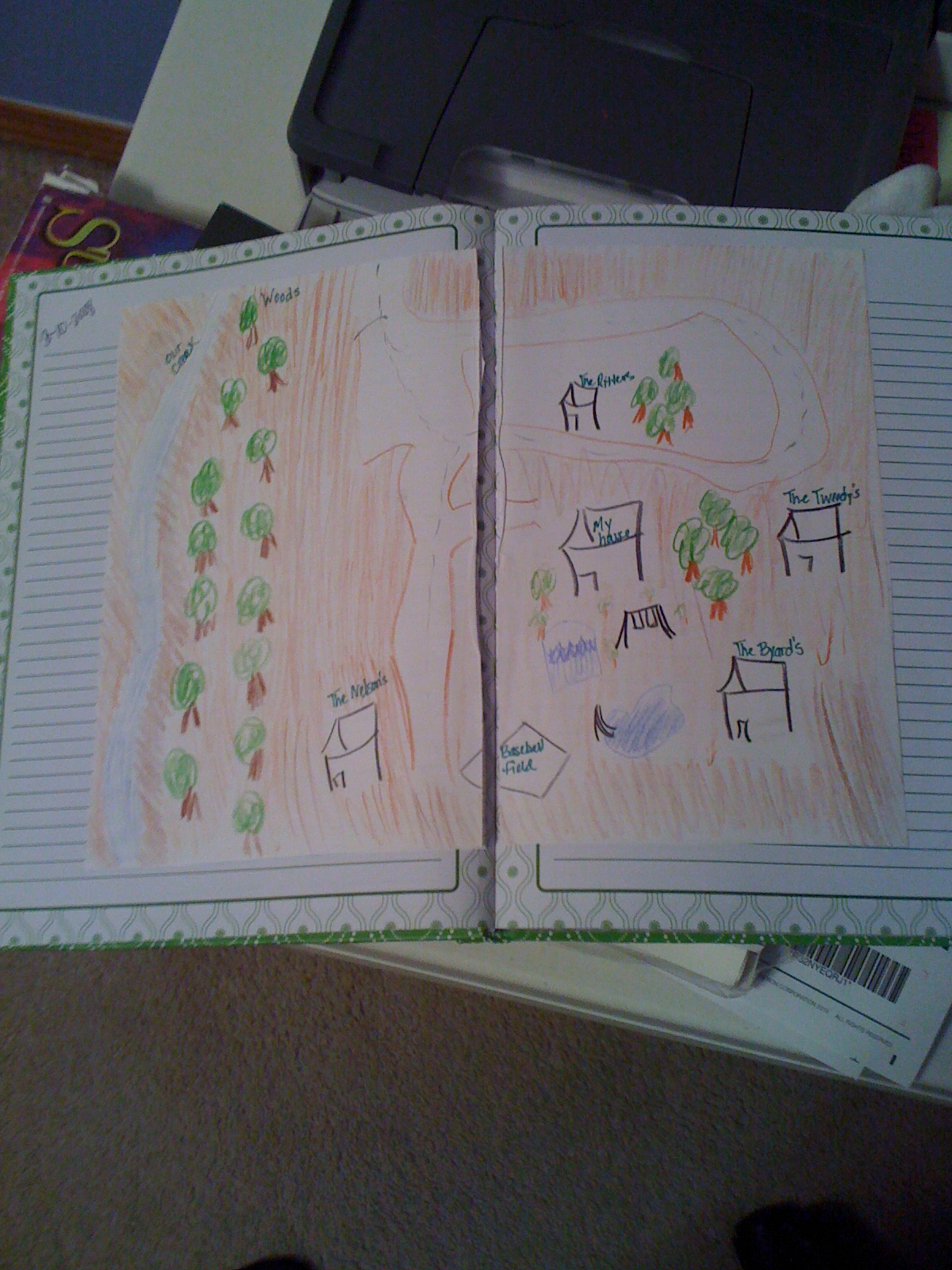
-House Maps are intended to do this same. Last year when I drew my house map the students noticed I begin just writing key phrases onto the paper. This happened because as I was talking to them about the different things in my house stories kept coming to mind that I wanted to write. I felt this was very important. They were able to see that the purpose wasn't to draw a pretty picture but truly brainstorm ideas.

-Heart Maps are designed to brainstorm what I call watermelon or big topics. Then I have the students share these big topics with their writing partners. Then as they discuss the big topics they write down seed ideas from their discussion of the big idea.

For more ideas about different maps you could use read the book My Map Book by Sara Fanelli.
3)Quick Writes: I hesitate even bringing these up so early because many people associate quick writes with writing prompts and that is not what I mean. The idea comes from Donald Graves' book My Quick Writes for Inside Writing. My students have loved several of his ideas. My favorite to start with is the hand brainstorm. You draw a picture of your hand and think of different stories that have touched her hand. For example, the first time I held my daughters, holding my grandmother's hand before she passed, giving a students a high five after they've accomplished a hard task...

I do not make all my writers brainstorm each time we practice. I do ask they complete the maps and the quick writes during the small moment unit of study, but I do not require them to do it each time they sit down to write. Sometimes kids come to you with many stories they want to write about. After my mini lessons for the day I tell my students they have a choice. Choice 1 is to go and write a story that is in their mind and heart. Choice 2 begin with the strategies I taught today (or previously they are listed on chart paper) and see if a story emerges. Choice 3 finish a story in their notebook. As teacher of writer's workshop I have evolved from all must do what I taught for the day each day. I let them move at their pace and write about their topic.
Wednesday, August 4, 2010
Journey As Writers
Journey of a Writer
pencils scribbling
eraser flecks
we are writers
pages rustling
minds engaging
we are writers
dream, hope
believe, breathe
WE ARE WRITERS
~LYS~
As my students begin their writing journey, I need to model for them and help them find ways to think about the stories in their hearts, but most importantly students must develop a sense of community within the classroom so they feel safe enough to share their writing.
1)MODEL, MODEL, MODEL: Not only should we as teachers model writing, but model what is sounds like to talk to another writer about their writing. I do this in my conferences, but I also do this when kids share their writing. I model by saying what I liked about their writing piece.
2) CHART PAPER IS YOUR FRIEND: Make a list of appropriate ways to compliment someone's writing. I keep my chart posted so that all students can see it. Most of the time I start of the chart with my own favorite prompts.
"I like the way you..."
"My favorite part was.....because..."
At first students will use "This reminds me of..." I explain to my writers that it is a compliment when their writing helps the reader make connections to their own life, but as we progress through out the year I try to make the students focus on the craft of writing.
3)SHARING IN SMALL GROUPS: I have students share in a smaller group before they come to the carpet for the sharing circle involving the entire class. This helps those that would not normally share in a large circle still have an opportunity to shine in a smaller setting.
Tuesday, August 3, 2010
Creating Writer's Notebooks
I love, love, love my writer's notebook! It is the place I put mementos that I cherish, stories that are in my heart, poems that echo in my mind and many other items that mean something to me. Students need to see what Writer's Notebooks are and what you do with them. The Amelia Bedelia books are ideal for introducing this type of writing.

Writer's Notebooks are a treasure chest of stories and ideas. To help remind students of this I give them a poem typed by by Brad Bogart. Students glue this into the cover of their notebook and then decorate their notebook. Then I use contact paper to cover and protect the notebook.
Writer's Notebook Poems by Brad Bagert
After we decorate our notebooks we take a look inside mine. The students and I sit on the carpet and take a stroll through the favorite pages of my own notebook. My goal with this day is to create a desire for them to write and save ephemera for their own notebooks. (If you would like a detailed post about what can go inside a notebook Ruth Ayer's at Two Writing Teachers has written a wonderful post about it.) Writer's Notebooks are a great way to rejuvenate writing in the classroom. It certainly changed mine four years ago!


Writer's Notebooks are a treasure chest of stories and ideas. To help remind students of this I give them a poem typed by by Brad Bogart. Students glue this into the cover of their notebook and then decorate their notebook. Then I use contact paper to cover and protect the notebook.
Writer's Notebook Poems by Brad Bagert
After we decorate our notebooks we take a look inside mine. The students and I sit on the carpet and take a stroll through the favorite pages of my own notebook. My goal with this day is to create a desire for them to write and save ephemera for their own notebooks. (If you would like a detailed post about what can go inside a notebook Ruth Ayer's at Two Writing Teachers has written a wonderful post about it.) Writer's Notebooks are a great way to rejuvenate writing in the classroom. It certainly changed mine four years ago!

Monday, August 2, 2010
SLICE OF LIFE~Stand Still
 Feel free to leave your own slice or read more slices at Two Writing Teahcrs
Looking at their faces tonight as they sleep I wish time would stand still. The hustle and bustle of our last days before school begins seemed to take hold today as Gracie screamed, "Princess dress!" down the aisles of Wal-Mart. But, now, now you rest. You are angels given to me and I am truly blessed and hopefully next time you are skipping down the aisles at the checkout yelling, "Nana kisses! Not Mommy kisses!" I will remember how sweet and QUIET you are when you sleep. I am tired from the day, but it is these days I cherish because I know soon, very soon you will be 16 asking for the car keys and not wanting any kisses unless they are from your boyfriend. How I wish time would stand still. Time, precious, quickly moving and tick-tick-ticking away.
Monday Musings
"There is no greater agony than bearing an untold story inside you." Maya Angelou

About a month ago I started preparing for my new school year and this quote popped out at me. One thing I want my students to realize is that we all have something to tell others whether it is a heartbreaking story of loss or a story of love---parents finding love after a bitter divorce or the day a new puppy arrived in the home and all the stories are important. The story doesn't have to be painful, heart wrenching, or over the top filled with excitement. What matters is telling the story. What Ms. Angelou wants us to realize is it is painful to not tell others the stories in our souls and hearts. There is no greater celebration to watch than a group of writers who have put a small piece of themselves on paper for others to savor and enjoy.
Some of the ways I plan to begin are simple
1) Writer's Notebook Creation: Set aside a few hours at the beginning of the year to create the notebook so students have a place to cherish their words.
2) Create a Community: Build a sense of sharing within the class community so all feel safe to share their stories that are essentially a piece of their heart.
3) Brainstorm: Show students ways to brainstorm the stories in their heart by listing important people and places in their life.
Subscribe to:
Posts (Atom)