Gone are the days of the only writing you do is out of the grammar book correcting and diagramming sentences. Grammar should be taught within the writing unit. Teachers need to use the child's writing. Practicing the endless sentences only teaches them to look at certain parts...or in my case it taught me to really dislike the English Grammar Rules. (Thanks to my Comp I professor) Grammar should be used within the child's writing--either in the notebook or in their drafts. ( I do lessons within my drafting and when we go back into our notebooks to practice. ) My lessons this week were from Jeff Anderson's Mechanically Inclined on beginning and ending punctuation and dialogue.
First I introduced dialogue with Knuffle Bunny by Mo Willems. I love to use this book because of the speech bubbles. Then my students and I look at a typed copy of the book and talk about things they notice. Then we discuss the "rules" of dialogue. I follow it up with making comic strips of their own. I have comic strip examples that we make into written dialogue and then they practice with their writing partner. After that they make comic strips and then a peer will write the dialogue in paragraph form. This has been hugely successful in the past.
Hope it works for you!
This is an exciting week for my writers!! CELEBRATION OF OUR PUBLISHED DRAFTS!!!
What are your writers working on?
Showing posts with label Writer's Workshop. Show all posts
Showing posts with label Writer's Workshop. Show all posts
Sunday, October 3, 2010


Thursday, September 23, 2010
The Art of Seeing Again
The revision process of writing used to be grueling and gut wrenching for my writers until we had George Ella Lyon speak at our school. She brought the many revisions to her picture book Mother to Tigers taped together and had the students hold a piece until the completed strand decorated the entire media center. I remember being in awe that day as I looked at this published author and how she slashed through pages of prose to ultimately have the perfect edition of the book. My writers were astonished as well. One of the conversations in our room after was how we use different lenses to revise. That revising means to see the piece in a different way. Today as I began this process with a new group of writers I explained that sometimes to grow as a writer it hurts a little bit. Letting go can provide a new opportunity for a better sentence or mental image for the reader. Meaningful revision, albeit sometimes painful, opens the door for a better writer and a published piece worthy of celebration.
 | |
| from Flickr Creative Commons http://www.flickr.com/photos/lytfyre/4425745183/sizes/m/in/photostream/ |
Sunday, September 19, 2010
Conferring With My Writers
Conferring time has become one of my favorite pieces of the writer's workshop. It's taken me a few years, but I've finally figured out what works for me. I make appointments with all my kids M-TH. Each day I meet with 5-6 students. These are the same each week. Before I begin conferecing I ask if anyone would like to sign up for a conference. If I have a list, I will try to get to them after I finish with my scheduled appointments. Typically at the beginning of the year not many students request one, but by the end of the year it can get quite long. The format I use when keeping notes is below.
Basic Conference Form for a Student
During my conferences, I stick with teaching one thing. This one thing will need to be something that will make them grow in their writing craft. We discuss their writing goal and look for evidence that they are working on it withing the piece they share with me.
This time is something that I have grown to cherish. What is your favorite time in writer's workshop?
Basic Conference Form for a Student
During my conferences, I stick with teaching one thing. This one thing will need to be something that will make them grow in their writing craft. We discuss their writing goal and look for evidence that they are working on it withing the piece they share with me.
This time is something that I have grown to cherish. What is your favorite time in writer's workshop?
Saturday, September 18, 2010
Drafting A Piece
On Friday, my students and I began looking at the ways we use our notebooks on a daily basis and deciding when it was time to move from our notebook to drafting a lesson. My activity idea stemmed from a post last year from Two Writing Teachers.
As we began to brainstorm what works in our notebooks and how it looks different outside the notebook. I realized how far these kids have come in four short weeks. As we began to discuss the importance of choosing a seed idea to grow their excitement began to take over. At this point in the workshop I stopped and we made the plan for our writing time together and I was then able to watch as my fifth graders dialogued with their writing partner about their notebooks and why certain entries are in the running to draft and others were not. By the end of the 20 minute session most of my students had an idea and were writing away adding to the entry and discussing with their partners how to make it better.
This next week students will be drafting and honing in on their writing craft in whole group and small group instruction. I will also meet with kids daily to confer about their writing and growing real writers. Where are you at in writer's workshop? Generating ideas? Honing the craft through drafting? Publishing?
As we began to brainstorm what works in our notebooks and how it looks different outside the notebook. I realized how far these kids have come in four short weeks. As we began to discuss the importance of choosing a seed idea to grow their excitement began to take over. At this point in the workshop I stopped and we made the plan for our writing time together and I was then able to watch as my fifth graders dialogued with their writing partner about their notebooks and why certain entries are in the running to draft and others were not. By the end of the 20 minute session most of my students had an idea and were writing away adding to the entry and discussing with their partners how to make it better.
This next week students will be drafting and honing in on their writing craft in whole group and small group instruction. I will also meet with kids daily to confer about their writing and growing real writers. Where are you at in writer's workshop? Generating ideas? Honing the craft through drafting? Publishing?
Wednesday, September 1, 2010
I Have Classroom Bloggers
Today my students launched their on-line blogs. I could not have done it without the help of Mrs. G! My students are very excited about their new blogs. I am sure we have hiccups to work through, but I am so proud of them for being patient and listening attentively. The exciting thing for me is that some of my students who weren't so pumped about at home writing are now very pumped! I highly recommend Weebly's services!!!
Tuesday, August 10, 2010
Building Stamina
I use an adapted/modified version of the Daily 5 in my room, and I love their chapter on how to build stamina in reading and writing. At the beginning of the year, we start out at 20 minutes, but my goal is to get to 45 minutes to an hour of uninterrupted writing by February. My 5th graders take a state mandated writing test and it is untimed, but I have found this to be very helpful in their stamina on the day of the writing test. They aren't surprised by the amount of energy exerted if we have rehearsed it daily.
How to Build Stamina
1) Set a timer for 20 minutes. After the day's mini-lesson explain to students that they are expected to write for 20 minutes today. Review the writing goal for the day and release them to write.
2) During this time I am conferring with students and listening. Writing means silence. When I begin to hear a buzz in the classroom or the timer ends I stop them and bring them back to the carpet.
3) We make our goal for the next day for how many minutes to write and move onto the next activity.
The hardest part for me while building stamina is ending early on the days the kids choose not to focus. I kept wanting them to "shhhh." But, if you keep track with a bar graph and record it, the students WANT to make the goal set for the day.
What do you do to build stamina for writing and reading in your classroom?
How to Build Stamina
1) Set a timer for 20 minutes. After the day's mini-lesson explain to students that they are expected to write for 20 minutes today. Review the writing goal for the day and release them to write.
2) During this time I am conferring with students and listening. Writing means silence. When I begin to hear a buzz in the classroom or the timer ends I stop them and bring them back to the carpet.
3) We make our goal for the next day for how many minutes to write and move onto the next activity.
The hardest part for me while building stamina is ending early on the days the kids choose not to focus. I kept wanting them to "shhhh." But, if you keep track with a bar graph and record it, the students WANT to make the goal set for the day.
What do you do to build stamina for writing and reading in your classroom?
Monday, August 9, 2010
Where to Work?
As I began to set up my classroom this week, I kept in mind the choice that students will have in where they will work. I have designed my room to fit the needs of those that like a work station and the ones who like to sit around the room. When establishing routines and procedures one of my mini-lessons will be about the place you choose to sit and work. I have tables in my classroom instead of desks and and the tables are in a U-shape on the outline of the edge of the carpet. This provides a huge space for my teaching time (always done on the carpet up front by the Smartboard) and for individual writing time.
Procedure for Choice Seating
1) Think about what you like. Do you prefer to lay on your stomach to write or sit up right?
2) Choose to sit somewhere where there aren't any distractions for you.
3) Make sure it's comfortable and you are able to write or read for at least 20 minutes.
4) Each day try a different spot until you find the right fit.
5) Once you choose a spot for the day, stay there. You may return to your seat if you find your chosen spot is uncomfortable but do not change locations in the classroom. (This prevents moving close to a friend after they have chosen a seat.)
6) Write, write, write.
Procedure for Choice Seating
1) Think about what you like. Do you prefer to lay on your stomach to write or sit up right?
2) Choose to sit somewhere where there aren't any distractions for you.
3) Make sure it's comfortable and you are able to write or read for at least 20 minutes.
4) Each day try a different spot until you find the right fit.
5) Once you choose a spot for the day, stay there. You may return to your seat if you find your chosen spot is uncomfortable but do not change locations in the classroom. (This prevents moving close to a friend after they have chosen a seat.)
6) Write, write, write.
Saturday, August 7, 2010
Boy Writers
There is a great post on Boy Writers at Two Writing Teachers. Take a look. This is one of my top 5 favorite books and it really changed how I get my boy writers to work in my room. I read this book in one sitting and laughed and realized what I needed to do to help my boys reach success in Writer's Workshop.
Thursday, August 5, 2010
Calling All Writers
The beginning of the school year means a clean slate with my writers. At the end of the year I always grieve that I have to start anew and fresh with writer's workshop and miss watching my current writers grow, but when it actually rolls around in the fall I overflow with excitement as I begin to look at what the journey will be for my new writers and me. I have a few lessons that are my favs that I start with at the beginning of the year.
Beginning Activities to Write
1) Listing: This has become one of my favorite activities to do when I am stuck and don't know what to write about. Lucy Calkins talks in her book Launching the Writer's Workshop that listing can be about people, places, feelings, and issues, but I also add important events, funny happenings in your life, and holidays. I model this process for my students in my writer's notebook and then I begin a small moment off one of the brainstormed ideas.
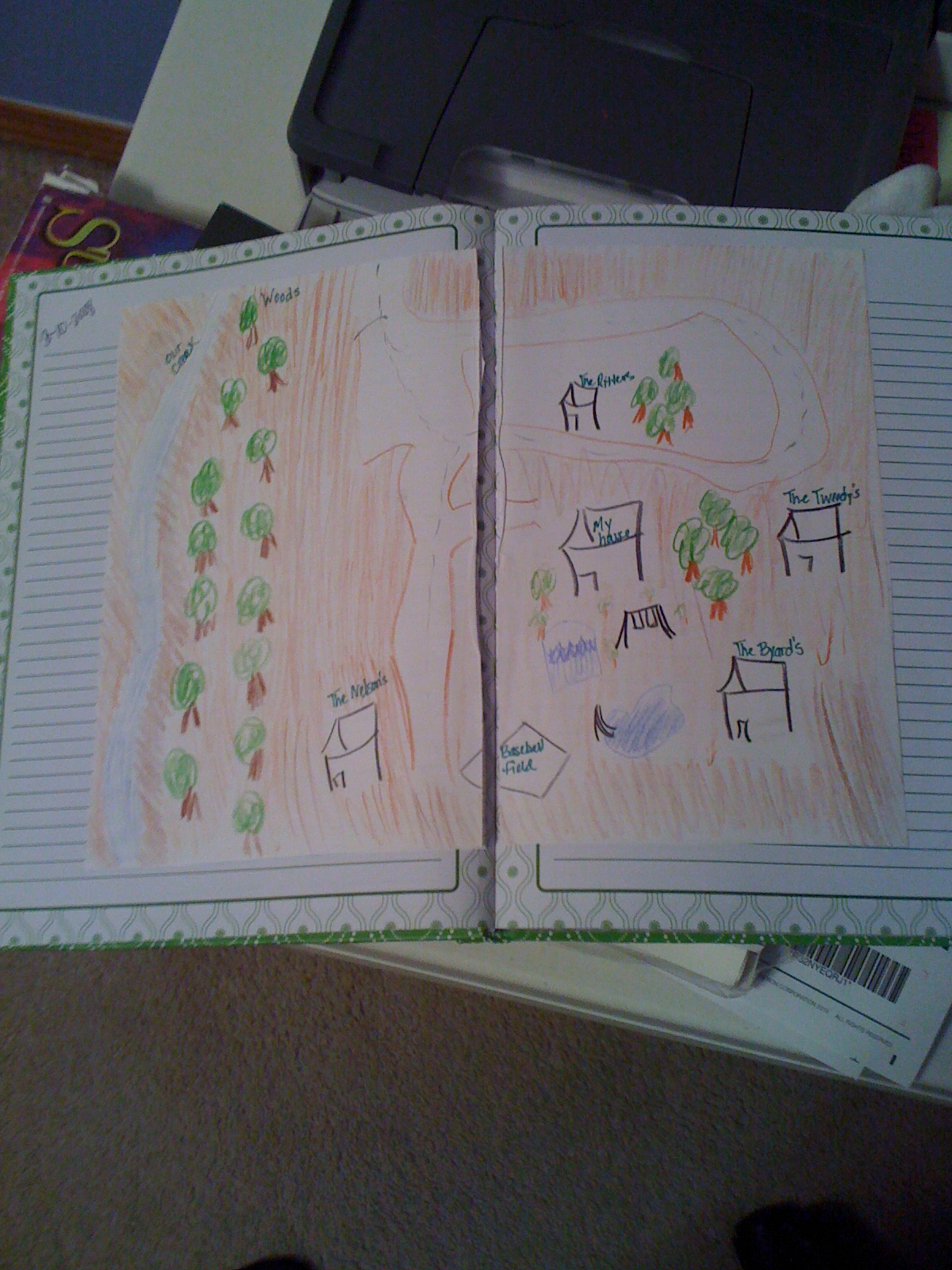
2)Mapping: I am not an artist...let me just clarify this now, but I love color so I tend to make my maps very colorful and I allow my students to spend lots of time on their maps. A few maps I have done in the past are neighborhood maps, house maps, and heart maps.
-Neighborhood Maps are drawn on paper pointing out key places and people where stories from growing up occurred. I have done a map of my childhood home and my house I live with my kids. The key to this type of map is not to list everything in your neighborhood, but as you are drawing stories pop up and you begin to mull over the memories which lead to stories.

-House Maps are intended to do this same. Last year when I drew my house map the students noticed I begin just writing key phrases onto the paper. This happened because as I was talking to them about the different things in my house stories kept coming to mind that I wanted to write. I felt this was very important. They were able to see that the purpose wasn't to draw a pretty picture but truly brainstorm ideas.

-Heart Maps are designed to brainstorm what I call watermelon or big topics. Then I have the students share these big topics with their writing partners. Then as they discuss the big topics they write down seed ideas from their discussion of the big idea.

For more ideas about different maps you could use read the book My Map Book by Sara Fanelli.
3)Quick Writes: I hesitate even bringing these up so early because many people associate quick writes with writing prompts and that is not what I mean. The idea comes from Donald Graves' book My Quick Writes for Inside Writing. My students have loved several of his ideas. My favorite to start with is the hand brainstorm. You draw a picture of your hand and think of different stories that have touched her hand. For example, the first time I held my daughters, holding my grandmother's hand before she passed, giving a students a high five after they've accomplished a hard task...

I do not make all my writers brainstorm each time we practice. I do ask they complete the maps and the quick writes during the small moment unit of study, but I do not require them to do it each time they sit down to write. Sometimes kids come to you with many stories they want to write about. After my mini lessons for the day I tell my students they have a choice. Choice 1 is to go and write a story that is in their mind and heart. Choice 2 begin with the strategies I taught today (or previously they are listed on chart paper) and see if a story emerges. Choice 3 finish a story in their notebook. As teacher of writer's workshop I have evolved from all must do what I taught for the day each day. I let them move at their pace and write about their topic.
Beginning Activities to Write
1) Listing: This has become one of my favorite activities to do when I am stuck and don't know what to write about. Lucy Calkins talks in her book Launching the Writer's Workshop that listing can be about people, places, feelings, and issues, but I also add important events, funny happenings in your life, and holidays. I model this process for my students in my writer's notebook and then I begin a small moment off one of the brainstormed ideas.
2)Mapping: I am not an artist...let me just clarify this now, but I love color so I tend to make my maps very colorful and I allow my students to spend lots of time on their maps. A few maps I have done in the past are neighborhood maps, house maps, and heart maps.
-Neighborhood Maps are drawn on paper pointing out key places and people where stories from growing up occurred. I have done a map of my childhood home and my house I live with my kids. The key to this type of map is not to list everything in your neighborhood, but as you are drawing stories pop up and you begin to mull over the memories which lead to stories.
-House Maps are intended to do this same. Last year when I drew my house map the students noticed I begin just writing key phrases onto the paper. This happened because as I was talking to them about the different things in my house stories kept coming to mind that I wanted to write. I felt this was very important. They were able to see that the purpose wasn't to draw a pretty picture but truly brainstorm ideas.

-Heart Maps are designed to brainstorm what I call watermelon or big topics. Then I have the students share these big topics with their writing partners. Then as they discuss the big topics they write down seed ideas from their discussion of the big idea.

For more ideas about different maps you could use read the book My Map Book by Sara Fanelli.
3)Quick Writes: I hesitate even bringing these up so early because many people associate quick writes with writing prompts and that is not what I mean. The idea comes from Donald Graves' book My Quick Writes for Inside Writing. My students have loved several of his ideas. My favorite to start with is the hand brainstorm. You draw a picture of your hand and think of different stories that have touched her hand. For example, the first time I held my daughters, holding my grandmother's hand before she passed, giving a students a high five after they've accomplished a hard task...

I do not make all my writers brainstorm each time we practice. I do ask they complete the maps and the quick writes during the small moment unit of study, but I do not require them to do it each time they sit down to write. Sometimes kids come to you with many stories they want to write about. After my mini lessons for the day I tell my students they have a choice. Choice 1 is to go and write a story that is in their mind and heart. Choice 2 begin with the strategies I taught today (or previously they are listed on chart paper) and see if a story emerges. Choice 3 finish a story in their notebook. As teacher of writer's workshop I have evolved from all must do what I taught for the day each day. I let them move at their pace and write about their topic.
Wednesday, August 4, 2010
Journey As Writers
Journey of a Writer
pencils scribbling
eraser flecks
we are writers
pages rustling
minds engaging
we are writers
dream, hope
believe, breathe
WE ARE WRITERS
~LYS~
As my students begin their writing journey, I need to model for them and help them find ways to think about the stories in their hearts, but most importantly students must develop a sense of community within the classroom so they feel safe enough to share their writing.
1)MODEL, MODEL, MODEL: Not only should we as teachers model writing, but model what is sounds like to talk to another writer about their writing. I do this in my conferences, but I also do this when kids share their writing. I model by saying what I liked about their writing piece.
2) CHART PAPER IS YOUR FRIEND: Make a list of appropriate ways to compliment someone's writing. I keep my chart posted so that all students can see it. Most of the time I start of the chart with my own favorite prompts.
"I like the way you..."
"My favorite part was.....because..."
At first students will use "This reminds me of..." I explain to my writers that it is a compliment when their writing helps the reader make connections to their own life, but as we progress through out the year I try to make the students focus on the craft of writing.
3)SHARING IN SMALL GROUPS: I have students share in a smaller group before they come to the carpet for the sharing circle involving the entire class. This helps those that would not normally share in a large circle still have an opportunity to shine in a smaller setting.
Tuesday, August 3, 2010
Creating Writer's Notebooks
I love, love, love my writer's notebook! It is the place I put mementos that I cherish, stories that are in my heart, poems that echo in my mind and many other items that mean something to me. Students need to see what Writer's Notebooks are and what you do with them. The Amelia Bedelia books are ideal for introducing this type of writing.

Writer's Notebooks are a treasure chest of stories and ideas. To help remind students of this I give them a poem typed by by Brad Bogart. Students glue this into the cover of their notebook and then decorate their notebook. Then I use contact paper to cover and protect the notebook.
Writer's Notebook Poems by Brad Bagert
After we decorate our notebooks we take a look inside mine. The students and I sit on the carpet and take a stroll through the favorite pages of my own notebook. My goal with this day is to create a desire for them to write and save ephemera for their own notebooks. (If you would like a detailed post about what can go inside a notebook Ruth Ayer's at Two Writing Teachers has written a wonderful post about it.) Writer's Notebooks are a great way to rejuvenate writing in the classroom. It certainly changed mine four years ago!


Writer's Notebooks are a treasure chest of stories and ideas. To help remind students of this I give them a poem typed by by Brad Bogart. Students glue this into the cover of their notebook and then decorate their notebook. Then I use contact paper to cover and protect the notebook.
Writer's Notebook Poems by Brad Bagert
After we decorate our notebooks we take a look inside mine. The students and I sit on the carpet and take a stroll through the favorite pages of my own notebook. My goal with this day is to create a desire for them to write and save ephemera for their own notebooks. (If you would like a detailed post about what can go inside a notebook Ruth Ayer's at Two Writing Teachers has written a wonderful post about it.) Writer's Notebooks are a great way to rejuvenate writing in the classroom. It certainly changed mine four years ago!

Monday, August 2, 2010
Monday Musings
"There is no greater agony than bearing an untold story inside you." Maya Angelou

About a month ago I started preparing for my new school year and this quote popped out at me. One thing I want my students to realize is that we all have something to tell others whether it is a heartbreaking story of loss or a story of love---parents finding love after a bitter divorce or the day a new puppy arrived in the home and all the stories are important. The story doesn't have to be painful, heart wrenching, or over the top filled with excitement. What matters is telling the story. What Ms. Angelou wants us to realize is it is painful to not tell others the stories in our souls and hearts. There is no greater celebration to watch than a group of writers who have put a small piece of themselves on paper for others to savor and enjoy.
Some of the ways I plan to begin are simple
1) Writer's Notebook Creation: Set aside a few hours at the beginning of the year to create the notebook so students have a place to cherish their words.
2) Create a Community: Build a sense of sharing within the class community so all feel safe to share their stories that are essentially a piece of their heart.
3) Brainstorm: Show students ways to brainstorm the stories in their heart by listing important people and places in their life.
Monday, November 16, 2009
Moving In Time
Today I taught my group of writers the art of moving in time to help the reader understand the meaning of the piece (idea from Raising the Quality of Narrative Writing by Calkins). However, I used a fabulous text Sweet, Sweet Memory. I also timelined the book to show how the piece moved from the present to the past and to the future at different points.
Lesson Plan
My writer's are wrapping their third small moment by "Putting Said to Bed" tomorrow and then going through the final stages of writing onto publishing. Once again I have nothing but wonderful things to say about this process. When my piece is finished I will post here.
Lesson Plan
My writer's are wrapping their third small moment by "Putting Said to Bed" tomorrow and then going through the final stages of writing onto publishing. Once again I have nothing but wonderful things to say about this process. When my piece is finished I will post here.
Monday, April 13, 2009
Memoir Monday~My Motherhood~
Note to the reader: My class and I are working on our memoir unit. This is my first draft. We talked all about the different forms to memoir and our big goal is to show meaning through our mental pictures. The section that is a flashback about Emma's Diagnosis was from a small moment I wrote earlier in the year. I was really able to explain how difficult I thought this was to write with my students. When they saw my reaction while reading it I think they understood how much this means to me. We talked about the defining moments of our lives and how it has to be the right time to put them down on paper. Some moments are ready and some are not.
*******
My Motherhood
By: Lynnelle
Motherhood seems so easy when you watch from the outside. Each day I “take care” of kids, but I never expected my journey of motherhood to change me so much. At first, the desire to be a mom was so strong my heart would ache to the point I thought my eyes would dry from all the tears that fell, each time I found out another couple’s baby was on the way.By: Lynnelle
I remember the day I found out I was going to be a mom. Excitement does not begin to express the way I felt. I called everyone to tell about our baby that was to be born on July 4th. Little did I know that her arrival would rock our universe.
Throughout my teaching career I believe that my life has been touched in some way by my students. I also feel that it is important that all children receive the best in education. Many people believe that I only advocate for children because my own child has a disability—but this was a strong piece of heart long before my girls arrived. As a teacher it is my responsibility to speak for a child when he or she is unable to make their voice heard.
My life did change after having Emma. The moment I heard her feeble cry and “it’s a girl” my heart danced with joy. Then my heart actually seemed to stop after we received her medical diagnosis.
******
Dr. Saddiqui and his messengers entered my room quietly. He came over to me. “I’m sorry, but we believe your daughter has Down syndrome,” he stated. “We are performing genetic testing and will have the results by Friday,” he continued. As the entourage left the room my mind swarmed with many confusing, racing thoughts. This isn’t happening. This can’t be happening! Not my daughter! This only happens to other people! My silent room was filled with emotional chaos. Outside my room the buzzing of the nurses continued, while the doctor’s voice echoed in my ears. I kept replaying the scene: genetic testing, no eye contact from the doctor, and I knew he was right. Emma had Down syndrome. Tears flowed down my cheeks in furious streaks and my temper flared!“There is nothing wrong with Emma! How can they even think that? I exploded. I could feel the protective instinct envelop my child even though I had only been a mother for 24 hours.
How can this be happening? How can I possibly wait 3 days to find out? What do I do? Well, I waited. I prayed. I visited my tiny baby. And I waited.
On Friday, the hospital social worker called and asked us to come up to the conference room. My heart was thumping in my chest as I walked into the elevator and then into the room. On the table sat a box of tissues. My heart sank. I gasped. My heart began to break into tiny pieces. My sobs could be heard own the hall.
“Shh…you don’t even know the results,” said the social worker.
I wanted to scream what!!! This is my child we’re talking about! Instead I quietly replied, “True, but I don’t believe the news is what we want to hear.” I pointed to the tissue box and sat down.
A rush of activity caught my attention. Dr. Saddiqui entered the room with an unfamiliar doctor. She was very animated and it was obvious she was talking about my daughter. She turned and smiled at us. Then it seemed the whole world came crashing down around me. While I tried to stop my sobs and tears, Dr. Moghadan tried to explain what it meant when she told us Emma had Mosaic Down syndrome. But, it seemed that someone had pressed the mute button. I could not speak; I could not hear her words. My mind was rushing with many different thoughts. Will she be “normal?” Will she fall in love? Will she walk or talk?
Dr. Moghadan’s words changed me. I was no longer a “new parent,” but a parent of a special needs child. Not only did her words change me, but they changed others. People went from saying, “Congratulations” to “I’m sorry,” as if someone had died. However, I learned a lot about my self that day. I would gladly sacrifice my life to prevent my child from being hurt.
For me motherhood isn’t about just being a mom. It is recognizing that we don’t know where our life journey will take us. If our path takes us on way that seems unexpected we must embrace it; learn from it.
*****
After Emma’s diagnosis I received the poem Welcome to Holland by Emily Perl Kingsley. It expressed in words I could not articulate about how my life changed.Now when I see tulips I am not just reminded of Spring and the rebirth of the flowers, trees and the smell of freshly cut grass, but the change to my life. My pace. My children’s pace. Don’t just endure hardships, but chose to grow.Welcome To HollandI am often asked to describe the experience of raising a child with disability - to try to help people who have not shared that unique experience to understand it, to imagine how it would feel. It's like this...... When you're going to have a baby, it's like planning a fabulous vacation trip - to Italy. You buy a bunch of guide books and make your wonderful plans. The Coliseum. The Michelangelo David. The gondolas in Venice. You may learn some handy phrases in Italian. It's all very exciting. After months of eager anticipation, the day finally arrives. You pack your bags and off you go. Several hours later, the plane lands. The stewardess comes in and says, "Welcome to Holland." "Holland?!?" you say. "What do you mean Holland?? I signed up for Italy! I'm supposed to be in Italy. All my life I've dreamed of going to Italy."
by Emily Perl Kingsley
©1987 by Emily Perl Kingsley
But there's been a change in the flight plan. They've landed in Holland and there you must stay. The important thing is that they haven't taken you to a horrible, disgusting, filthy place, full of pestilence, famine and disease. It's just a different place. So you must go out and buy new guide books. And you must learn a whole new language. And you will meet a whole new group of people you would never have met. It’s just a different place. It's slower-paced than Italy, less flashy than Italy. But after you've been there for a while and you catch your breath, you look around.... and you begin to notice that Holland has windmills....and Holland has tulips. Holland even has Rembrandts. But everyone you know is busy coming and going from Italy... and they're all bragging about what a wonderful time they had there. And for the rest of your life, you will say "Yes, that's where I was supposed to go. That's what I had planned."And the pain of that will never, ever, ever, ever go away...because the loss of that dream is a very very significant loss. But... if you spend your life mourning the fact that you didn't get to Italy, you may never be free to enjoy the very special, the very lovely things ... about Holland.
As a mother and a teacher, my desire to impact others by helping them see the world and others in a different way burns deeply in my heart. I don’t know if my life story will change others, but hopefully the way I choose to treat others through my actions will plant a seed for other people to join me in my heart’s desire.
Tuesday, March 31, 2009
Memoir
Today I introduced Memoir to my kids and it went great. We read two stories, The Relatives Came by Cynthia Rylant and What You Know First by Patricia Maclachlan. We talked about what is in our own notebooks. My students know what it is mine so together we looked through it and came up with 3 Life Themes. Then students looked into their notebooks and came up with their own themes. Tomorrow we are going to look at 3 different chapters of Knots on my Yo-Yo String by Jerry Spinelli. Our focus is to look at why people write memoir before we begin writing our own.
My 3 Themes that appear most often in my notebook are
1)My family-my daughters and days from my childhood
2)Remembering who I am-thoughts I have about myself and how I am growing
3)When my eldest daughter received the diagnosis-Mosaic Down syndrome
My 3 Themes that appear most often in my notebook are
1)My family-my daughters and days from my childhood
2)Remembering who I am-thoughts I have about myself and how I am growing
3)When my eldest daughter received the diagnosis-Mosaic Down syndrome
Monday, February 16, 2009
Brain Overload
Today our school had an opportunity to listen to Constance Foland a literacy consultant in New York and New Jersey schools. It was magnificent. Invigorating. Listening to her, I felt as if I needed to holler "amen!" every now and then. It was extremely affirming that the practices I have implemented in the last 4 years are exactly what is best for kids. However, I also left with ways to improve upon my current workshop practices. I loved the conferring and assessing session. I feel this is my area of weakness even though it has improved from last year. I love that we were able to look at a piece of real text by children authors and discuss what we would do if we were conferring with the writer. It created insight and the realization that even as teachers we see the piece through different lenses. I began to wonder do I only use one lens or do I make sure the way I look at my student's work is balanced? I left with Ponderings...when you leave with these you know it was a good professional development day
Sunday, February 8, 2009
Memoir Monday~The News
**This piece was written with my students and revised with them as we began our journey to "revising to be better writers" series.**
Dr. Saddiqui and his messengers entered my room quietly. He came over to me. “I’m sorry, but we believe your daughter has Down syndrome,” he stated. “We are performing genetic testing and will have the results by Friday,” he continued. As the entourage left the room my mind swarmed with many confusing, racing thoughts. This isn’t happening. This can’t be happening! Not my daughter! This only happens to other people! My silent room was filled with emotional chaos. Outside my room the buzzing of the nurses continued, while the doctor’s voice echoed in my ears. I kept replaying the scene: genetic testing, no eye contact from the doctor, and I knew he was right. Emma had Down syndrome. Tears flowed down my cheeks in furious streaks and my temper flared!
“There is nothing wrong with Emma! How can they even think that? I exploded. I could feel the protective instinct envelop my child even though I had only been a mother for 24 hours.
How can this be happening? How can I possibly wait 3 days to find out? What do I do? Well, I waited. I prayed. I visited my tiny baby. And I waited.
On Friday, the hospital social worker called and asked us to come up to the conference room. My heart was thumping in my chest as I walked into the elevator and then into the room. On the table sat a box of tissues. My heart sank. I gasped. My heart began to break into tiny pieces. My sobs could be heard own the hall.
“Shh…you don’t even know the results,” said the social worker.
I wanted to scream what!!! This is my child we’re talking about! Instead I quietly replied, “True, but I don’t believe the news is what we want to hear.” I pointed to the tissue box and sat down.
A rush of activity caught my attention. Dr. Saddiqui entered the room with an unfamiliar doctor. She was very animated and it was obvious she was talking about my daughter. She turned and smiled at us. Then it seemed the whole world came crashing down around me. While I tried to stop my sobs and tears, Dr. Moghadan tried to explain what it meant when she told us Emma had Mosaic Down syndrome. But, it seemed that someone had pressed the mute button. I could not speak; I could not hear her words. My mind was rushing with many different thoughts. Will she be “normal?” Will she fall in love? Will she walk or talk?
Dr. Moghadan’s words changed me. I was no longer a “new parent,” but a parent of a special needs child. Not only did her words change me, but they changed others. People went from saying, “Congratulations” to “I’m sorry,” as if someone had died.
However, I learned a lot about my self that day. I would gladly sacrifice my life to prevent my child from being hurt. Now four years later, I see and experience the love of my daughter~who does talk, who does walk, and “woves” me.
Thursday, January 8, 2009
Big Picture Series-It's a Matter of Choice
Today Ruth discusses the importance of choice in the Writer's Workshop and I love how she describes her journey to this element of the Workshop in her room. I think all teachers struggle with choice. Such as how much choice? When I was talking with other colleagues about the aspect of choice in the WW I was keenly aware that each of us were on the same, but different journey.
I tend to allow choice within genre. For example, students choose what they want to write within the unit of study of personal narrative, essay writing, memoir, etc. However, some teachers allow not only choice of topic, but choice of genre. So, the mini-lesson of the day may or may not apply to the student, but all are expected to then apply it when they try that genre of writing.
I have not nor have I thought of this before. This absolutely amazed me because I still have not let go of somethings. Now granted 5th graders are expected to have mastered the art of essay writing by Feb. due to state mandated testing and that is probably what drives my avoidance of letting go, but I do wonder like Ruth..could I do it? Could I handle all the different genres that may be written at one time in a room of 30? What about the students who need the black and white of the writing process? Food for thought....thanks, Ruth!
I tend to allow choice within genre. For example, students choose what they want to write within the unit of study of personal narrative, essay writing, memoir, etc. However, some teachers allow not only choice of topic, but choice of genre. So, the mini-lesson of the day may or may not apply to the student, but all are expected to then apply it when they try that genre of writing.
I have not nor have I thought of this before. This absolutely amazed me because I still have not let go of somethings. Now granted 5th graders are expected to have mastered the art of essay writing by Feb. due to state mandated testing and that is probably what drives my avoidance of letting go, but I do wonder like Ruth..could I do it? Could I handle all the different genres that may be written at one time in a room of 30? What about the students who need the black and white of the writing process? Food for thought....thanks, Ruth!
Monday, January 5, 2009
Thesis Statements
Tomorrow I am teaching Session 6 from Book 3 of Breathing Life Into Essays. It is a very simple lesson on narrowing your focus into a thesis statement to prepare for drafting an essay...basically asking yourself "What is it I am trying to say?"
As I looked through my own entries for the personal essay, I wrote many meaningless entries. At the time it seemed significant, but now a few weeks later they aren't inspiring. Which I am sure some of my students will feel tomorrow. So I went back and looked at my small moment entries from earlier in the year. My last published piece with my students was about the day I found out my daughter has Down syndrome. Many entries are about my experience whether positive or negative with the community. So I tried Amy Buckner's Try 10 strategy from her book Notebook Know-How. Here goes.
As I looked through my own entries for the personal essay, I wrote many meaningless entries. At the time it seemed significant, but now a few weeks later they aren't inspiring. Which I am sure some of my students will feel tomorrow. So I went back and looked at my small moment entries from earlier in the year. My last published piece with my students was about the day I found out my daughter has Down syndrome. Many entries are about my experience whether positive or negative with the community. So I tried Amy Buckner's Try 10 strategy from her book Notebook Know-How. Here goes.
- Don't view people by what you think you know, but what you actually know.
- Disability does not mean retarded.
- Having a child who is considered disabled changed by life in many ways.
- Normalcy is never achieved in our lifetime.
- Everyone should be treated fairly, regardless of any difference the world may or may not see.
- Disability does not mean impossibility.
- People who live with a disability are truly amazing people.
- Disabled is a word that can break the heart of parents, but it is a reality in many people's lives.
- Children living with a disability should not be mistreated.
- When we look at others we should look at their heart and soul.
Sunday, January 4, 2009
Back to School
Back to school we go tomorrow! We are currently working on an action research project as a grade level. This is one that I am extremely excited about. We have 5 sections of LA/SS teachers at our site. 2.5 of us are taking the Lucy Calkins route for writing test prep and 2.5 of us are taking the more formal 5 paragraph song and dance routine for writing test prep. I am on the Lucy side of things and I am writing the daily lesson plans from Book 3: Breathing Life into Essays. I am using Lucy's Lessons as a guide and adding my own "isms" in it. We have been meeting weekly to discuss how it is going in the classroom. We started Dec. 1, but missed almost a week due to ice before the holidays.
I am so excited about this process. So far the students are responding very well to the essay process. They understand that there are different genres of writing and this is a new genre. At the same we (the 2.5 using Lucy's WW) will be trying Katherine Bomer's ideas from her latest book, Writing a Life. I am very excited about the process we are trying because writing takes place daily in my classroom. However, we also have to get the students ready for a test. So, this provides them with authentic writing and test prep. So this week my students will be writing thesis statements and framing our essays. Cheers to a great writing journey!
I am so excited about this process. So far the students are responding very well to the essay process. They understand that there are different genres of writing and this is a new genre. At the same we (the 2.5 using Lucy's WW) will be trying Katherine Bomer's ideas from her latest book, Writing a Life. I am very excited about the process we are trying because writing takes place daily in my classroom. However, we also have to get the students ready for a test. So, this provides them with authentic writing and test prep. So this week my students will be writing thesis statements and framing our essays. Cheers to a great writing journey!
Subscribe to:
Posts (Atom)